
The use of a science GPA calculator is necessary for students who intend to join any profession in the medical field, engineering, biology, chemistry, and so forth. Unlike a GPA, which calculates all academic subjects, the GPA calculator only considers science and math subjects, therefore giving the right calculation of your science GPA. As either a high school or university student intending to join professional schools, knowing how to calculate your science GPA is highly important. This article will enlighten you on all there is concerning the GPA science calculator, from its calculation to methods of improving your grade.
What is a science GPA calculator?
The GPA science calculator is an advanced form of calculator that helps in computing the grade point average of subjects associated with science. This list may encompass subjects such as biology, chemistry, physics, mathematics, environmental science, and anatomy & physiology. Although there are GPA calculators that can compute GPAs for all courses, a science GPA calculator will only work out the grades of science subjects, which have particular significance for some career options.
The significance of science GPA becomes even more important in the scenario where a person plans on applying for admission to institutions such as medicine, dentistry, pharmacy, and engineering schools, along with other science subjects. It is essential for admission purposes because a science GPA reflects one’s proficiency in complex subject areas, which are important for success in these academic programs.
How it Works
The science GPA calculator works on the principle of only taking into account your science-related classes to calculate an average GPA for all your science courses. To begin with, you enter the name of the class, along with the grade earned, and in certain instances, the credit hours for the respective science classes as well. Once the names and grades of the science classes have been entered, the next step entails the conversion of those grades from letters into numeric figures. After that, you multiply the grade points by the credit hours and sum up the results to get your exact science GPA score.
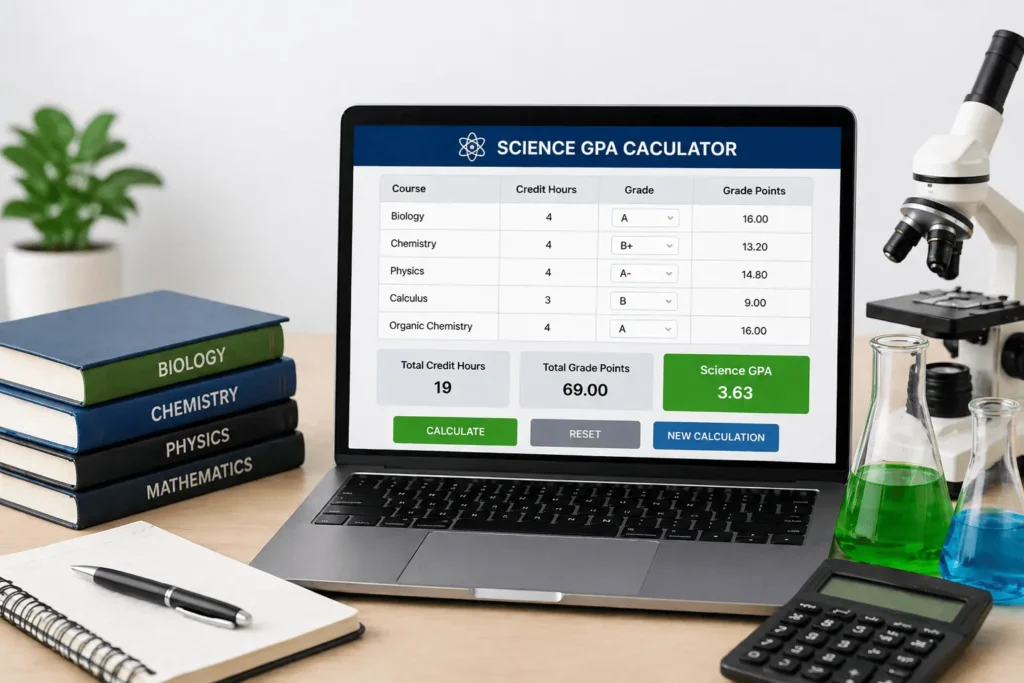
Guide to Calculate Science GPA
It should be noted that calculating one’s science GPA is not as complicated as many people think it is. Nevertheless, an individual should take certain steps to make sure that the process goes smoothly. The first step here is creating a list of all the courses in science that you have ever taken. These are usually biology, chemistry, physics, and mathematics courses.
Next, the grades and credit hours should be written down for each course. At the third step, one will have to convert the letter grade into grade points. It is usually done using the four-point GPA scale. Afterwards, one will multiply the grade points by the number of credit hours in a given course. After that, one will have to add up the grade points and credit hours for each course.
Benefits of Using
There are some notable benefits that a GPA calculator in the sciences provides to students. First, it reduces the time required since it immediately gives the outcome without waiting for manual computation. Second, there is an absence of errors because computing your GPA on paper requires much effort, particularly if you have many subjects.
Third, it helps in monitoring your progress since you can assess yourself based on past performances and pinpoint certain aspects that need enhancement. Fourth, it becomes helpful in planning your academics since your knowledge of your GPA lets you create realistic targets and choose relevant subjects.
Frequent Mistakes
When calculating a GPA with the use of a scientific GPA calculator, there are several mistakes that many learners make, which affect the accuracy of their calculations. Some learners tend to forget about course credits, bearing in mind that the credit value differs from one subject to another, which greatly influences the calculation. Additionally, learners incorporate courses that do not belong to the sciences or mathematics field, although the GPA calculator takes into account only these kinds of subjects. Learners also have trouble determining the right grading system since they are not aware that some colleges have varying GPA schemes.
Tips to Improve Your Science GPA
With low GPA performance in the sciences, there are many ways through which you can increase your grades. First, focus on your weak areas and work to improve them. You must also improve your study skills, as this will help boost your grades. In addition, you should learn how to make effective study plans and also apply the best study methods to improve your studies. efficiency. Moreover, you should feel free to seek external help now and then by having your lecturer explain some things to you.
Why Colleges Care About Science GPA
The science GPA is something that colleges give considerable attention to, as it gives an idea of the student’s capability in handling challenging and technical courses. In terms of medical school, engineering schools, and other related science programs, a student needs to have a solid background in courses like biology, chemistry, and math. A separate review of the Science GPA can determine this information.
Moreover, science classes usually require logical reasoning, problem-solving abilities, and perseverance, all of which are absolutely essential not only in academia but also throughout their professional careers. Having high grades in science shows that the student can cope with difficult subjects and perform well in them for a prolonged period of time. At the same time, it helps universities to evaluate whether a student is prepared for higher education.
Conclusion
A science GPA calculator is not only about the calculation itself but also about the opportunity to gain knowledge and improve your academic progress within science classes. You can gauge your strengths and areas for improvement by calculating your grades in technical subjects.
Whatever method you use for the calculations, manual or an online GPA calculator, it will help you become more conscious of academic choices and build better plans for the future. Calculate your science GPA now, keep up the excellent work, and succeed.
FAQ’s
Q1. In what ways does the science GPA differ from the overall GPA?
The difference lies in the fact that the science GPA takes science subjects only into account, whereas the GPA covers all subjects. A science GPA is particularly crucial for those pursuing medicine or technology courses.
Q2. Is it possible to calculate a science GPA using a calculator that supports weightage?
It depends on the calculator whether it can calculate weighted GPA, which means higher marks for advanced classes.
Q3. Why is my science GPA lower than my total GPA?
This discrepancy may be because science courses are relatively difficult, have higher credit units, and hence result in a science GPA lower than the total GPA.
Q4. Is it possible to use one calculator for multiple institutions?
Yes. However, ensure that the calculator is appropriate for the institution concerned by ensuring that your credits and grading system match.
Q5. How reliable are the free online GPA science calculators?
This information is reliable, provided that your information concerning grades and credit units is correct.